Do flight prices drop after you book? (What real fare data shows)
Updated July 15, 2026 · Last verified against US DOT/BTS Consumer Airfare Report (Q1 2026) July 15, 2026
The Short Answer
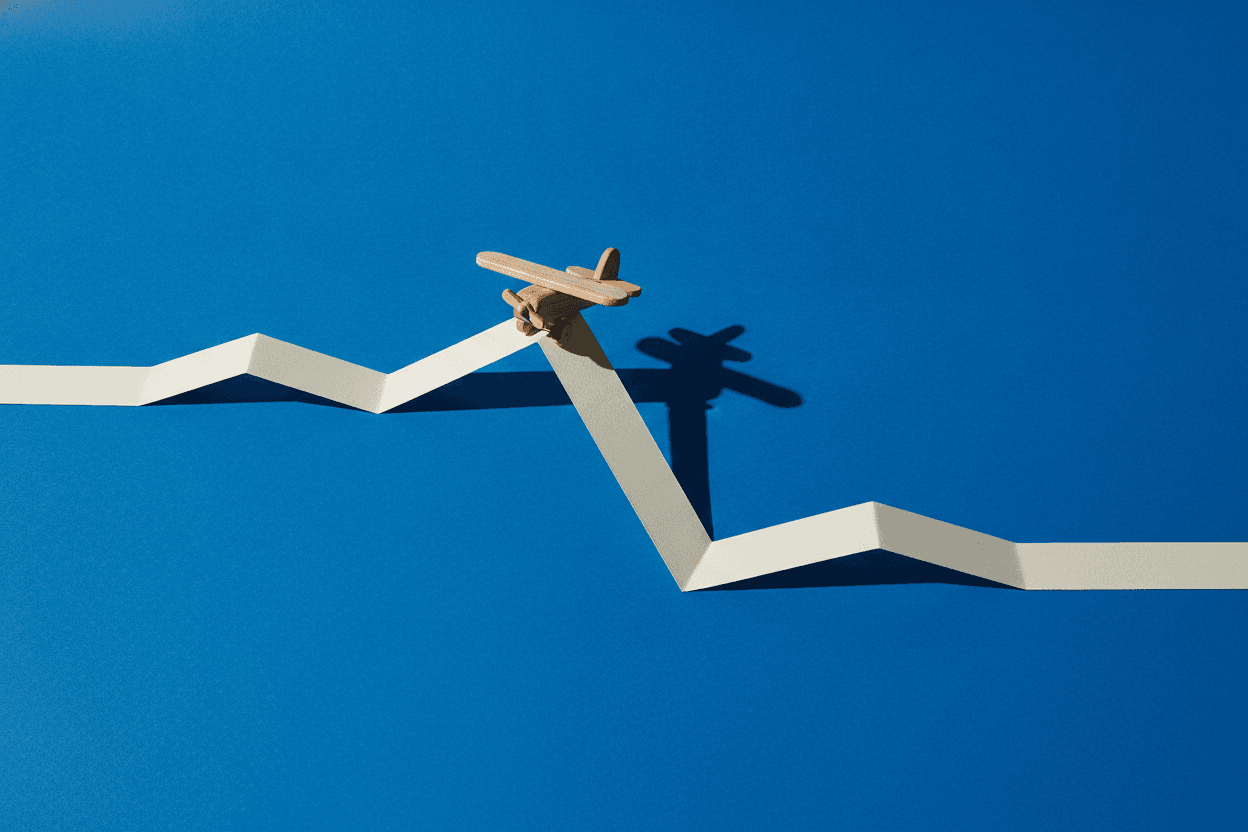
Yes. Not sometimes, not in rare glitches — routinely. The price you paid was one frame of a movie that keeps playing after you stop watching, and the question that actually matters isn't whether your flight will get cheaper. It's whether your ticket's rules let you do anything about it when it does.
Why do fares keep moving after you buy?
Airlines don't set a price for a flight; they run a continuous auction against their own forecast. Every flight's cabin is carved into fare buckets, and revenue-management systems reopen, close, and reprice those buckets constantly as bookings come in faster or slower than predicted. A route under-filling three weeks out gets cheaper seats released. A competitor drops a fare and the system answers within hours. None of this consults the fact that you already bought.
So a post-booking drop isn't a mistake or a sale you "just missed" — it's the ordinary output of the machine. The proof is that airlines maintain entire reprice and credit workflows for exactly this event. You don't build a process for something that never happens.
How often, and how big?
Honest labeling first: the ranges below are typical patterns, not a promise about your booking. Our watched-booking dataset will replace them with real distributions as it grows; until then, here's the shape.
Small wobbles are constant; claim-worthy drops — big enough to be worth acting on — are less frequent but entirely routine over the life of a booking made weeks or months out. Size scales with the fare:
- Economy drops are usually modest. For context, the average U.S. domestic itinerary fare was $428 in Q1 2026 (U.S. DOT Bureau of Transportation Statistics) — when a whole ticket costs $428, even a healthy drop is measured in tens of dollars, typically $50–$300 when one clears a claim threshold.
- Premium cabins are where the swings get violent. Business and first fares run multiples of that $428 average, and they reprice in lurches, not wobbles — a single international premium ticket can move $500–$4,000. Typical when it happens, never promised. The full size breakdown lives in how much can you get back.
Does a drop mean you get money back?
Here's the part the question is really asking, and the answer is: it depends entirely on your fare's rules, not on the drop.
| Your ticket | Can you capture a drop? | What you'd get |
|---|---|---|
| Standard fare (Main cabin and above) | Usually yes, on most U.S. airlines | Travel credit for the difference — not cash |
| Any ticket, first 24 hours after booking | Yes (US DOT rule, 7+ days to departure) | Cancel for a full cash refund, rebook lower |
| Basic Economy | No, after the 24-hour window | Nothing |
| Award ticket (miles/points) | Generally not a reprice | Sometimes cancel-and-rebook for a miles redeposit |
| Refundable fare | Yes, by construction | Cash refund on cancel, rebook at the new price |
What should you actually do about it?
Three moves, in order of leverage:
- Inside 24 hours of booking? That's the cash window — cancel and rebook at the lower fare under the DOT 24-hour rule. The one time a drop means real money back to your card.
- On a standard fare, any time after? Reprice the same flights for travel credit. The mechanics differ sharply by airline — website quirks, phone scripts, who blocks what — which is why each one has its own playbook: Delta, United, American, Southwest (the friendly one), Alaska, JetBlue, and the full airline table.
- Keep watching. Prices keep moving after your first claim, and every new drop below your repriced amount is a fresh one. This is the tedious part — checking your exact fare brand against your exact flights, repeatedly, for months — and it's precisely the part Gadabout automates: forward the confirmation, we watch the exact itinerary and fare brand, and tell you when a claim is worth making.
Do flight prices drop after booking FAQ
- Do flight prices go down after you book?
- Yes, routinely. Airlines reprice fares continuously through revenue-management systems, so post-booking drops are a normal event, not a fluke. Whether you can capture one depends on your fare brand: standard fares can usually reprice for travel credit; Basic Economy and award tickets generally cannot.
- Can I get money back if my flight price drops after I book?
- Usually in the form of airline travel credit, not cash — you reprice the same flights and the difference comes back as a credit with an expiry date. Cash happens in narrower cases: within 24 hours of booking under the US DOT rule, on refundable fares, or when the airline cancels on you.
- Which flights drop the most after booking?
- Premium cabins, by a wide margin. Business and first fares run multiples of the $428 average U.S. domestic itinerary fare (DOT, Q1 2026) and swing hard — drops of $500–$4,000 on a single ticket are typical when they hit, though never guaranteed. Economy drops are usually $50–$300.
- Why does Google Flights show a lower price than what I'd get repricing?
- Because it's often quoting a different fare brand — frequently Basic Economy — or a different booking channel. A reprice claim requires your exact flights, cabin, and fare brand to be cheaper. Always compare like to like before calling.
- How long after booking do flight prices keep changing?
- Until departure. Fares move through the entire booking curve, often with a volatile stretch in the final weeks as airlines react to how the flight is filling. That's why watching continuously beats checking once — drops don't schedule themselves.
Sources
Synthesized from public U.S. DOT/BTS fare data (Consumer Airfare Report, average domestic itinerary fare $428 in Q1 2026) and the booking mechanics documented across our airline and portal playbooks. Range figures are typical patterns from watched bookings, not promises; this page updates quarterly as the price-history dataset grows.
See what this looks like on your own trip
Forward a confirmation and we show you your own flights, class, and fare — and which recovery form, credit or cash, each drop would pay. Free during beta.